When a strategic decision falls outside an organization's usual experience, leaders often start by dabbling.
They gather research, talk to people they trust, and exchange opinions. Calendars fill up. Everyone feels productive. But when it's time to decide, the team has plenty of opinions and little clarity.
Consider a leadership team weighing a move into a new market. The CEO has spoken with an advisor. The CFO has run some numbers. The head of sales has heard from two enthusiastic customers.
Each leader arrives with a different view of the opportunity. The discussion swings between the safest option and the most exciting one. Neither has been tested.
Teams that make sound strategic decisions take a more disciplined approach. They hear different perspectives, challenge assumptions, and evaluate options against shared criteria. The goal is informed conviction.
One tool I use with leadership teams is a Risk versus Reward matrix. Each option is plotted by how likely it is to fail and how much it could deliver. Then we ask:
"Which options offer meaningful upside at a level of risk we can accept?"
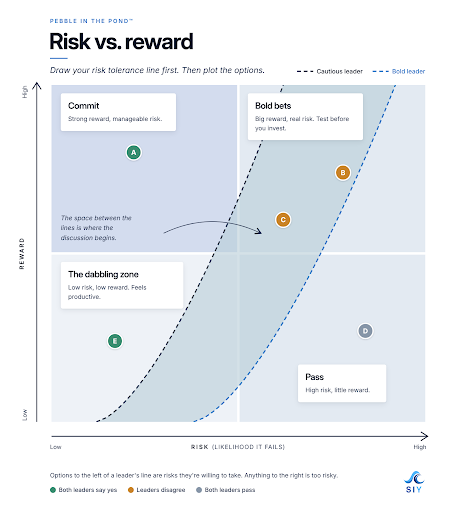
The matrix sorts options into four areas.
Commit: strong reward at a manageable level of risk. These are the options most teams agree on quickly.
Bold bets: big reward, but real risk. These deserve testing before significant investment.
The dabbling zone: low risk and low reward. This is where teams spend time when they're not ready to decide. It feels productive, but it rarely changes the outcome.
Pass: high risk with little reward. These options should be set aside.
Before plotting any options, I ask each leader to draw their own risk tolerance line on the matrix. Options to the left of the line are risks they're willing to take. Anything to the right is too risky for them.
When we do this together, the lines rarely match. A more cautious leader draws a line toward the left, taking on more risk only when the reward is substantial. A bolder leader draws further to the right, willing to accept longer odds for a bigger payoff.
Both perspectives are valid. But when those differences go unspoken, leaders end up debating individual options while overlooking the source of their disagreement: how much risk they're willing to accept.
Plotting the options against both lines makes this visible. Some options fall to the left of both lines, and the leaders agree to move forward. Some fall to the right of both, and the leaders agree to pass. The options that fall between the lines are the ones the bold leader would pursue and the cautious leader would not.
The space between those lines is where the discussion should begin.
Those options deserve closer scrutiny because they reveal where leaders hold different views of acceptable risk. Once the team agrees on a collective risk tolerance, it can evaluate every option against a shared standard.
Two conditions make this exercise useful.
First, a shared language. In our Circumstance Model™ work, teams agree on their current circumstances and how to describe them before developing scenarios. If leaders define "high risk" or "high reward" differently, their assessments will be inconsistent.
Second, intellectual safety. Drawing an honest risk line requires the freedom to disagree and challenge assumptions. The Safety Diamond™ describes this as intellectual safety. Leaders need to feel comfortable expressing their views, especially when those views differ from the CEO's. Otherwise, the most senior person's tolerance for risk becomes the default.
Gary Klein's premortem technique offers another useful test. Before committing, imagine the decision has failed. Ask each person to explain what went wrong. The exercise helps teams challenge optimistic assumptions and develop more realistic estimates of risk.
The Pebble
1. Dabbling delays decisions. Research has value when it helps a team reach a conclusion. Set a point when exploration ends and the team must decide.
2. A clear process builds confidence. Give leaders room to share their perspectives and challenge assumptions. Evaluate the options using the same criteria so the recommendation reflects the evidence.
3. Define your risk tolerance early. Ask each leader to draw their risk line before discussing the options. Agree on the team's collective tolerance so everyone understands the boundaries for the decision.
The Ripple
Think about the most important strategic decision on your team's agenda.
Plot the alternatives on a Risk versus Reward matrix.
Ask each leader to draw their risk tolerance line independently before comparing options. Put the lines side by side and discuss why they differ.
Examine the options that fall between the lines. Ask: "Do we have enough evidence to assess the risk, or are we relying on hope?"
Notice how many options sit in the dabbling zone. If most of your team's energy is going there, ask what is keeping you from a real decision.
The answers will help you see whether your team is ready to decide or needs to do more work.
The Question
What important decision is your team debating, and have you agreed on how much risk you're willing to accept?