Clear Communication in Critical Leadership Moments
There are leadership moments that you never forget, the ones when the stakes are high and you know how much the understanding of the message matters. Being clear is the priority, along with your steadiness, confidence, and patience. And yet, in the moment, you don’t show up the way the situation demands.
Scenarios where we can be challenged include:
Announcing a restructuring
Justifying an acquisition
Explaining difficult decisions driven by the economy
Delivering “good news” that creates winners and worriers at the same time
Whatever the situation, your intent may not match the impact. Your audience feels that gap immediately.
Communication is not a box to check. It’s emotional work that can be time consuming, but the payoff is worth it. Ignoring that reality or expecting people to stay unemotional and unquestioning often undercuts the human entered culture we often say that we value.
Three Key Leadership Takeaways
1. Preparation is respect for your audience.
Before stepping in front of your organization, pause and consider what’s already on their minds. If you’re announcing layoffs, assume fear. If you’re announcing an acquisition, assume uncertainty. If you’re announcing growth, assume someone is wondering what it means for them.
Anticipating reactions isn’t about controlling the narrative—it’s about honoring the people who have to live with the consequences.
2. Stay steady when understanding is uneven.
You may have had weeks to process the decision and the message. Your team has had seconds.
When people ask questions you think you’ve already answered, or react in ways you didn’t expect, your job is to stay grounded, not defensive. Clarification without condescension is leadership. Arrogance, even subtle, erodes trust faster than any decision ever will.
3. Differing opinions are where strength lives.
Leadership isn’t about achieving 100% agreement. It’s about understanding where people are reacting or diverging—and being patient with the why. Bold actions almost always reveal blind spots. When leaders treat differing opinions as information rather than irritation, direction becomes sharper and trust becomes sturdier.

This Week’s Ripple Effect
Questions of Challenge
Where in your leadership have you taken a bold action and then been asked questions you weren’t prepared for?
When have you reacted emotionally in the moment—and how did that affect alignment?
Conversely, when have you held steady despite internal emotion—and what was different about the outcome?
A Challenge – Tell Stories
As you think about your own leadership moments—the heavy ones, the emotional ones, the high-stake ones—I’d love to hear what you’ve learned.
When did you have to deliver tough news and realize afterward that your delivery shaped the outcome more than the message?
When have you watched a leader stay clear and steady in a tough moment—and seen the whole room shift?
When has a lack of preparation or empathy created friction that didn’t need to happen?
If you’re willing, share a moment that taught you something about appropriate communication and the emotional work of leadership.
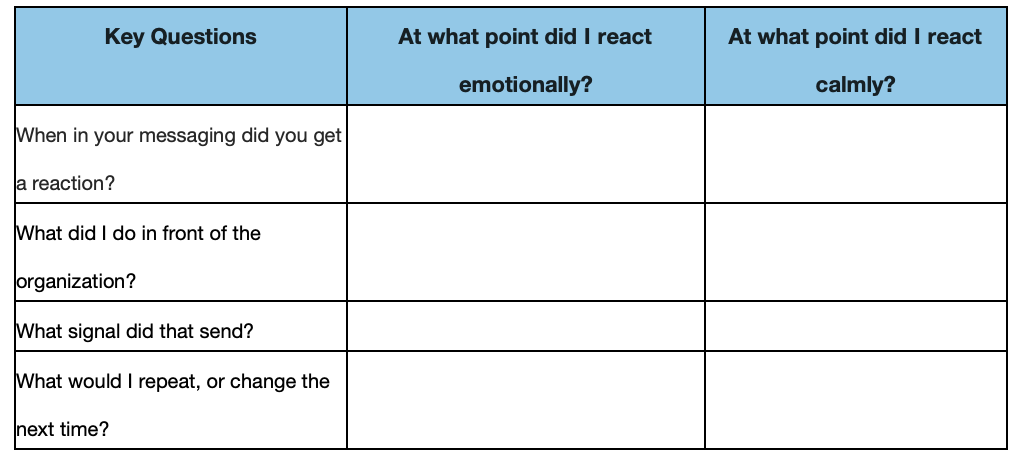
A Simple Exercise
Create a two column table based on a recent interaction with your team.
At what point did I react emotionally?
At what point did I react calmly?
Key Scenario Questions:
When in your messaging did you get a reaction?
What did I do in front of the organization?
What signal did that send?
What would I repeat, or change the next time?