One of the greatest gifts we can give another person is our full attention.
But between notifications, travel schedules, deadlines, family commitments, and competing priorities, presence has become increasingly rare. And distraction is not always visible. It doesn't require a phone, a laptop, or another meeting. Sometimes it is simply a wandering mind.
I have discovered this in my own life. Whether with family, clients, or friends, there are moments when I appear to be listening but am actually processing the next flight, the next project, or the next decision. The intention is never disrespect. The impact, however, can feel exactly that way.
Stephen Covey observed that most people do not listen with the intent to understand. They listen with the intent to reply.
The cost is real. The American Psychological Association has summarized research showing that shifting between tasks can cost as much as 40 percent of a person's productive time. Gloria Mark and her colleagues at UC Irvine found that people who are interrupted often compensate by working faster, but they experience more stress, frustration, and time pressure in the process. Many leaders associate multitasking with productivity. The evidence suggests it erodes decision quality and relationships.
Last week, I shared a Risk versus Reward matrix and asked leaders to draw their own risk tolerance lines. That exercise only works when people are fully in the room. If leaders are half-listening, the lines they draw reflect assumptions, not honest views.
This week's lens builds on that idea.
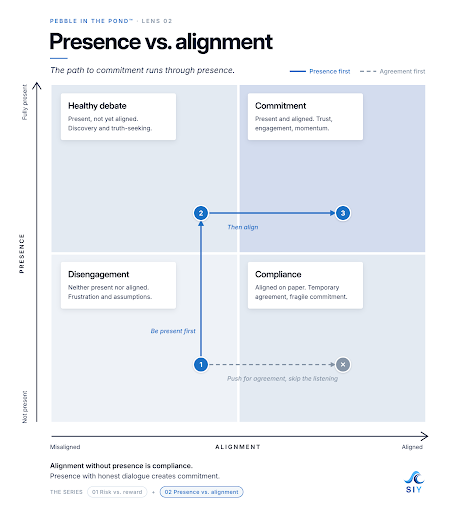
The matrix plots two things: how present people are in the conversation, and how aligned they are on the outcome.
Disengagement: neither present nor aligned. People make assumptions, frustration builds, and energy drifts elsewhere.
Compliance: aligned on paper, but not present. People agree in the meeting and then act on their own interpretation afterward. The commitment is fragile.
Healthy debate: present, but not yet aligned. People are listening, challenging, and discovering. It can feel uncomfortable, but it's productive.
Commitment: present and aligned. Trust, engagement, and momentum follow.
The most important insight is the path between the quadrants. Many leaders try to move a team straight from disengagement to agreement. They push for a decision before people have truly been heard. The result is compliance.
The path to commitment runs through presence. First, people need to be fully engaged in the conversation. Then the team can work through its differences and align.
Alignment without presence is compliance. Presence with honest dialogue creates commitment.
The encouraging news is that presence is not a trait. Jon Kabat-Zinn, whose work helped bring mindfulness into medicine and mainstream leadership, describes it as paying attention on purpose, in the present moment. Three decades of research on mindfulness practices point to improvements in focus, emotional regulation, and empathy. Presence is a discipline that can be strengthened through intentional practice.
It also costs almost nothing. Organizations invest heavily in technology, strategy, and process improvement, yet many overlook one of the simplest competitive advantages available: giving people your full attention.
Presence is not perfection. It is the intentional decision to be where your feet are.
The Pebble
1. Attention communicates value. People quickly recognize whether they have your focus. Full presence sends a powerful signal that what they are saying matters.
2. Alignment requires presence. Teams, families, and organizations cannot align around a shared vision when people are only partially engaged. Agreement reached without real listening rarely survives the meeting.
3. Listening often creates more impact than speaking. In my advisory work, the insights clients value most often emerge from thoughtful listening rather than from delivering answers. The best leaders I know are not always the smartest voices in the room. They are often the best listeners.
The Ripple
Think about a conversation from the past week where you were not fully present.
What was occupying your attention?
What opportunity may have been missed because your mind was somewhere else?
Look at the decisions your team made recently. Which ones reflect real commitment, and which ones may reflect compliance?
This week, choose one meeting, family dinner, walk, or conversation and intentionally remove distractions. Commit to being fully present. Notice what changes.
The Question
What is one habit, ritual, or discipline that helps you become fully present when it matters most?
Joe-ism: "Alignment begins long before a decision is made. It starts when people believe they have been heard."