Circumstance. Scenario. Alignment.
People sometimes ask me how much leadership changes as a company grows. Last week gave me a useful answer.
Within a few days, I sat in on strategic discussions with two companies at very different stages. One generates less than $30 million in annual revenue. The other, more than $500 million.
Both teams could see an opportunity in front of them. They believed the market was there. They had capable people working on it.
And both were wrestling with the same question:
Why aren’t we achieving what we believe is possible?
I’ve heard some version of that question in companies of almost every size.
The circumstances change as a business grows. There are more customers, more people involved in decisions, more dependencies, and usually more at stake. But the work of making a good decision remains surprisingly consistent.
It starts with understanding the circumstance.
Before deciding what should happen next, the team needs a shared view of what is happening now. What do we know? What has changed? Where are we performing well? What is getting in the way?
I call this the Circumstance Model.
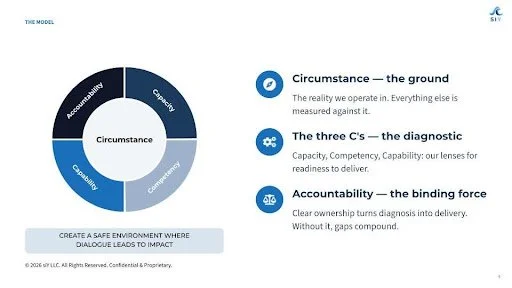
It sounds simple, but teams often move through this part too quickly. People arrive at the table with different interpretations of the problem, then immediately begin debating solutions.
That usually means they are solving different problems without realizing it.
Once there is a shared understanding of the circumstance, the conversation can move to scenarios.
My friend and longtime board member Eric McCarthy reinforced this lesson for me years ago: Always develop more than one possible path forward.
If a team develops only one answer, the meeting becomes an exercise in defending it.
Put several credible scenarios on the table and the conversation changes. People become more curious. Assumptions are easier to challenge. An idea from one scenario can improve another.
Then comes the harder part: deciding.
There is no scenario without uncertainty. So I tend to look at the choices through two lenses:
What is the probability, and what is the risk?
What outcome do we expect, and what would the impact be if we are right or wrong?
The purpose is not to predict the future perfectly. It is to understand the tradeoffs well enough to make a thoughtful choice.
Then you commit.
Once the decision has been made, the organization needs alignment around the path forward. Continuing to relitigate the choice only makes execution harder.
The businesses I spent time with last week were separated by hundreds of millions of dollars in revenue. Yet the leadership work in the room was much the same.
The Pebble
Complexity scales. The discipline of good decision-making does not.
Whether you are leading a $30 million company or a $500 million one, the sequence remains remarkably consistent:
Understand the circumstance.
Explore the scenarios.
Make the decision.
Align around the path forward.
The Ripple
The next time your team faces an important decision, notice where the conversation begins.
If people are already debating solutions, go back and ask whether everyone agrees on the circumstance.
If one answer has become the obvious answer, create a few credible alternatives before committing.
And once the decision is made, make sure the debate gives way to alignment.
A better decision process will not remove uncertainty.
It will help your team move through it together.
The Question
Think about the last difficult decision your team faced.
Where did the process break down: understanding the circumstance, exploring the scenarios, or aligning once the decision was made?
Be Safe. Be Inspired. Be You.
-Joe Morgan