The Signal You’re Ignoring
Most leadership teams benchmark obsessively against direct competitors, category averages, and the same analyst reports everyone else reads. The instinct is rational: when the pressure is on, you reach for what's measurable and familiar. But familiarity is not the same as insight.
The most consequential gaps in how organizations perform rarely show up in a competitive benchmark. They show up in the distance between what your stakeholders experience and what they've come to expect from every interaction in their lives. Your client doesn't compare your responsiveness to your closest competitor's. They compare it to the last company that made them feel like a priority.
The cross-industry signal
I was reminded of this recently at The Phoenix Hotel in Atlanta, where I was staying during MODEX. What struck me wasn't the politeness of the staff; hospitality trains for politeness. It was something more structural. Every employee I encountered appeared to operate from the same internal logic. They weren't following a script; they were making micro-decisions in real time about how to add value to my experience.
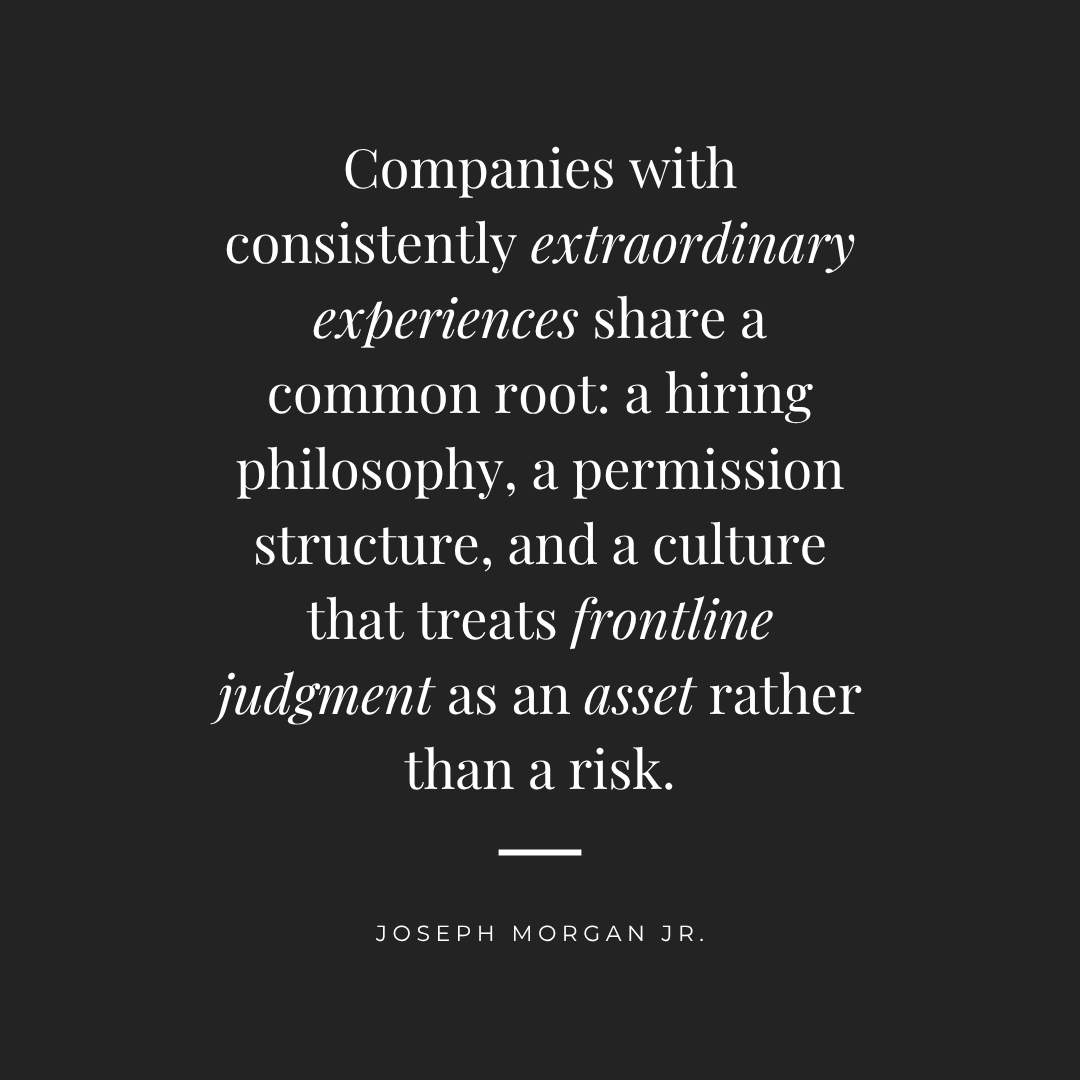
That kind of consistency comes from a hiring philosophy, a permission structure, and a culture that treats frontline judgment as an asset rather than a risk. And it exposes a question that category benchmarks are designed to avoid.
The harder question
Leadership teams often ask: Are we the best in our category?
A more productive question is: If the people we serve designed their ideal experience today, how far would it be from what we currently deliver?
That gap is where relevance lives. And it's widening faster than most leaders realize, because expectations aren't shaped by industry norms anymore. They're shaped by the best experience someone had last Tuesday.
The Ripple
Map your own expectation shifts. Identify five to seven organizations (in any sector) where you've personally experienced something that changed your expectations.
Ask: What did this organization understand about me that my own organization might not understand about the people we serve?
The pattern across those answers will tell you more about your blind spots than a competitive analysis will.Reverse-engineer what impressed you. The next time you experience something extraordinary outside your domain, a seamless onboarding or a service recovery that actually strengthened your trust, don't stop at "that was great." Ask: What decision, system, or permission structure made that moment possible?
Trace recurring friction to its source. When the same friction points keep surfacing, resist treating them as execution problems. Ask whether the underlying process or operating assumption has simply aged out of relevance. The most expensive habit in leadership is optimizing a system that should be replaced.
A 30-day practice
For the next month, build a simple experience log. Each time you interact with an organization and something stands out - positive or negative - capture four things:
What happened
What likely made it possible
What it felt like
What it suggests for your organization
Do this consistently and patterns will surface. Those patterns, grounded in lived experience rather than abstracted data, can become some of the most powerful inputs for rethinking how your organization creates value.